Istanbul Florence Nightingale Hospital
As of 8 September 2026
Read patient reviewsFUE, DHI and FUT hair transplant techniques performed by specialist surgeons in a JCI-accredited hospital, with a focus on natural-looking, long-term results.
Send enquiry↗At Florence Nightingale Hospitals, hair transplant planning begins with an assessment of hair loss, donor hair availability and individual needs. Our specialists develop personalised treatment plans designed to achieve natural-looking results while taking future hair loss into account. Careful donor area management and long-term planning help support results that remain appropriate over time
5.0/5
57 verified patient reviews
Istanbul Florence Nightingale Hospital
As of 8 September 2026
Read patient reviews
Newsweek & Statista
Gayrettepe Florence Nightingale Hospital
Included in the Türkiye list
View the hospital rankingWe’ve worked with patients from 100+ countries, supporting cases ranging from straightforward procedures to complex treatments.
A hospital, a surgeon, a diagnosis. Then a transplant — if a transplant is actually the answer.
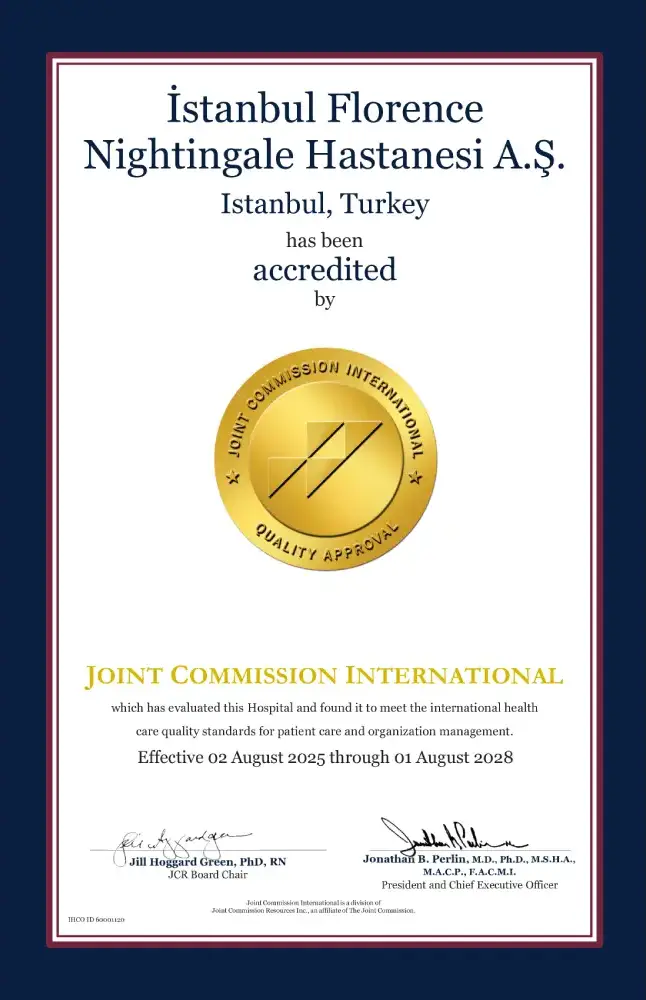
View certificate
Performed by experienced hair transplantation surgeons within a JCI-accredited hospital, with sterile theatres and full medical backup
Diagnosis first: we identify the cause and stability of your hair loss before proposing surgery, because not all thinning is pattern hair loss
Donor-first planning — an honest assessment of how many grafts your donor area can safely give, across your lifetime rather than this session
Medical treatment of ongoing loss planned alongside surgery, so the hair you keep is protected while the transplanted hair grows
Realistic graft numbers and hairline design, in writing, before you travel or pay anything
Full international coordination: visa invitation letter, transfers, accommodation, interpreters and structured remote follow-up through the full 12-month growth cycle

Follicles harvested one at a time and placed into the thinning zone, leaving scattered pinpoint marks rather than a line. The most commonly chosen technique, suitable for most patients.
Grafts placed with an implanter pen in a single step, giving fine control over angle and direction — particularly useful along the hairline and in eyebrow work.
FUE using sapphire-tipped blades to open the recipient channels, allowing closer graft placement and denser packing in the frontal zone.
A thin strip of donor scalp is removed and dissected into grafts, leaving one fine concealed line. Still the better option for some patients with extensive loss and limited FUE-accessible donor area.
For patients who want to minimise visible downtime, selected cases can be done without shaving the recipient area. It limits how many grafts fit in one session — we’ll tell you honestly if your case suits it.
Female pattern loss behaves differently, and thinning in women more often has a treatable medical cause. We investigate first, and use unshaven techniques wherever we can.
Restoring or thickening facial hair with scalp donor grafts, with close attention to angle — facial hair grows very differently to scalp hair, and getting that wrong shows immediately.
Camouflaging surgical or traction scars, and correcting previous transplants — unnatural hairlines, visible plugs, depleted donor areas. We plan these conservatively.
Scalp exam, trichoscopy and blood work to establish the actual cause of your hair loss before anyone recommends surgery.
Explore starting prices for selected treatments and ask our team for a personalised quote.
Request a personalised quote↗| Treatment | Starting from (GBP) |
|---|---|
| FUE — Follicular Unit Extraction |
£1,600 |
| DHI — Direct Hair Implantation |
£1,900 |
| Sapphire FUE |
£1,900 |
| FUT — Follicular Unit Transplantation |
£1,600 |
| Female Hair Transplant |
£1,600 |
| Beard, Moustache & Eyebrow Transplant |
£1,600 |
Starting prices in GBP. Your final quote will be confirmed after assessment.
Magnified scalp exam measures how many grafts your donor area can safely give. Over-harvesting it is permanent, so this number sets the plan, not your budget.
Classifying how far your hair loss has progressed, and whether it's still active, shapes the surgical plan and whether medical treatment should run alongside it.
Grafts start deteriorating the moment they leave the scalp. Storage conditions and the speed of implantation affect how many grafts ultimately survive and grow — invisible in a photo, decisive in your final density.
Drawn for your face shape and likely future loss, with grafts angled to follow your natural growth direction rather than placed for day-one impact.
A transplant redistributes hair you already have. Donor supply, hair calibre and your own loss progression set the ceiling — anyone promising an exact number is guessing.
FUE harvests follicles individually with no linear scar. DHI places grafts with a pen for fine control over angle, usually in smaller sessions. FUT removes a strip of donor scalp for a higher graft yield with one concealed line. Your donor supply decides which fits, not fashion.
It depends on your donor density and the area to cover. Photos let us give an initial range before you travel; be wary of anyone quoting a high number sight unseen.
It’s a surgical procedure with local anaesthesia and several hours in theatre. Complications are uncommon but real, and a hospital setting means proper sterility and immediate help if it’s ever needed.
Because the follicles enter a resting phase after being moved. Shedding at weeks two to eight is normal — the follicle stays put and regrows.
In selected cases, yes, though it limits how many grafts fit in one session. We’ll tell you honestly whether your case suits it.
We provide an itemised quote after assessing your scalp, based on the procedure, technique and follow-up required. We avoid per-graft pricing — that model is exactly what pushes some clinics to over-harvest a donor area.
Let us know what kind of support you need. We'll be in touch within 24 hours.
Loading enquiry form…