Istanbul Florence Nightingale Hospital
As of 8 September 2026
Read patient reviewsAdvanced prostate diagnostics, laser surgery and personalised treatment — supported by international patient services from day one.
Send enquiry↗
5.0/5
57 verified patient reviews
Istanbul Florence Nightingale Hospital
As of 8 September 2026
Read patient reviews

Newsweek & Statista
Gayrettepe Florence Nightingale Hospital
Included in the Türkiye list
View the hospital rankingWe’ve worked with patients from 100+ countries, supporting cases ranging from straightforward procedures to complex treatments.
Fewer unnecessary procedures. Faster answers. Treatment chosen for your case, not for the calendar.
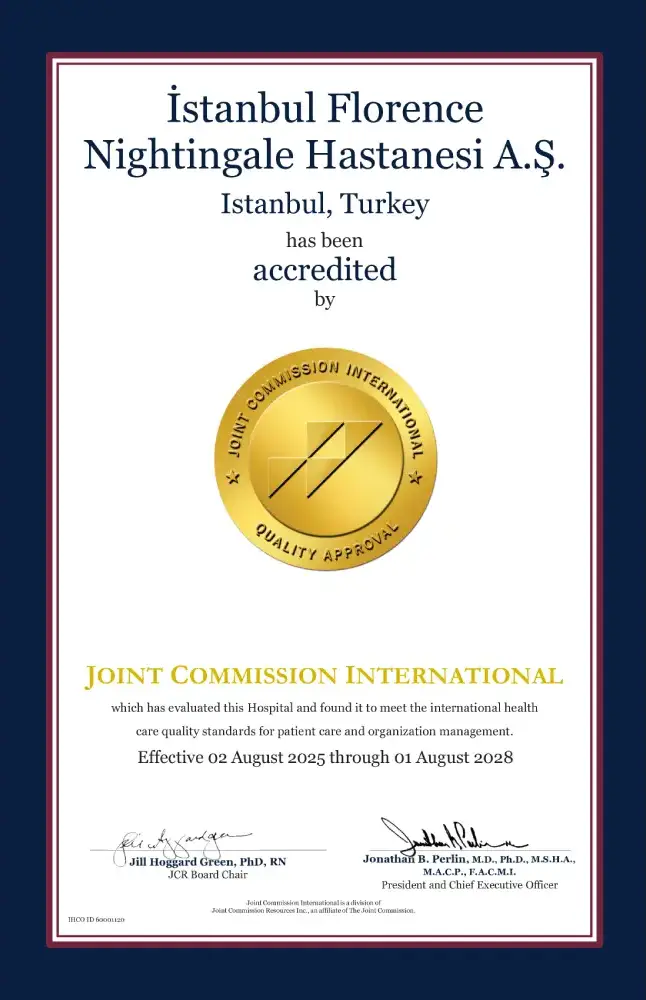
View certificate
Urologists with international training and decades of combined experience in laser prostate surgery and uro-oncology
Multidisciplinary board for prostate cancer: urology, medical oncology, radiation oncology, nuclear medicine and pathology reviewing your case together
JCI-aligned protocols, private recovery suites, and remote follow-up after you fly home
Size-independent laser enucleation (HoLEP and ThuLEP) — an option even for very large prostates and for patients on blood thinners
Full diagnostic chain on-site: PSA and hormone panels, 3T multiparametric prostate MRI, MRI-fusion biopsy, and Ga-68 PSMA PET-CT
JCI-aligned protocols, private recovery suites, and remote follow-up after you fly home

Baseline and follow-up prostate-specific antigen measurement, interpreted alongside prostate volume, age and PSA density rather than in isolation.
3T imaging with T2, diffusion and dynamic contrast sequences, reported using PI-RADS scoring to decide whether a biopsy is needed at all.
Targeted cores from PI-RADS 3–5 lesions plus systematic sampling, under sedation or general anaesthesia.
Whole-body PSMA imaging for staging high-risk disease and for biochemical recurrence after surgery or radiotherapy.
Objective measurement of urine flow rate and retained volume — the numbers that decide whether BPH needs surgery.
Pressure-flow assessment for complex voiding problems, overactive bladder and post-prostatectomy incontinence.
Prostate volume, bladder wall changes and kidney assessment in a single visit.
Direct flexible or rigid inspection of the urethra and bladder for haematuria, strictures and bladder tumours.
Full endocrine profile for suspected testosterone deficiency or infertility.
Detailed andrology laboratory testing for male infertility evaluation.
Assesses arterial inflow and venous leak in erectile dysfunction before treatment is chosen.
Additional staging where indicated, reviewed together with PSMA PET-CT findings.
Cardiovascular risk, blood pressure, lipids, glucose and HbA1c, thyroid, liver and kidney function, vitamin D, colorectal cancer screening and BMI/body composition — because prostate health is rarely the only thing worth checking.
Yes. Send your PSA results, MRI and any biopsy reports, and a urologist will review them and speak with you by video before you book anything.
Both remove the obstructing prostate tissue endoscopically by enucleation, and both work at any prostate size. The difference is the laser energy used: holmium (HoLEP) or thulium (ThuLEP). Thulium cuts with particularly fine hemostatic control, which can be an advantage for men on blood thinners. Your surgeon recommends one based on your prostate volume, anatomy and medical history.
Almost certainly not. Laser enucleation is size-independent, which is why it has largely replaced open prostatectomy for very large glands.
Most patients stay 1–2 nights, with the catheter usually removed within 24–48 hours. Plan roughly 5–7 days in Istanbul in total so your follow-up check happens before you fly.
A standard biopsy samples the prostate blind. A fusion biopsy overlays your MRI onto live ultrasound so suspicious lesions are targeted directly — which finds more clinically significant cancers and avoids over-diagnosing harmless ones.
Mainly in two situations: accurate staging before treatment of intermediate or high-risk prostate cancer, and locating recurrence when PSA starts rising after surgery or radiotherapy — often while PSA is still very low.
Erectile function is generally preserved. However, retrograde ejaculation — semen passing into the bladder instead of outward — is common after enucleation. It is harmless but relevant if you are planning to father children, so tell your surgeon beforehand.
Absolutely. We arrange accommodation for family members and provide interpreter support throughout the stay.
Securely through our online portal or by email to the international patient desk. All data is protected and confidential.
Once diagnostics are complete, most procedures are scheduled within 24–72 hours.
Let us know what kind of support you need. We'll be in touch within 24 hours.
Loading enquiry form…